

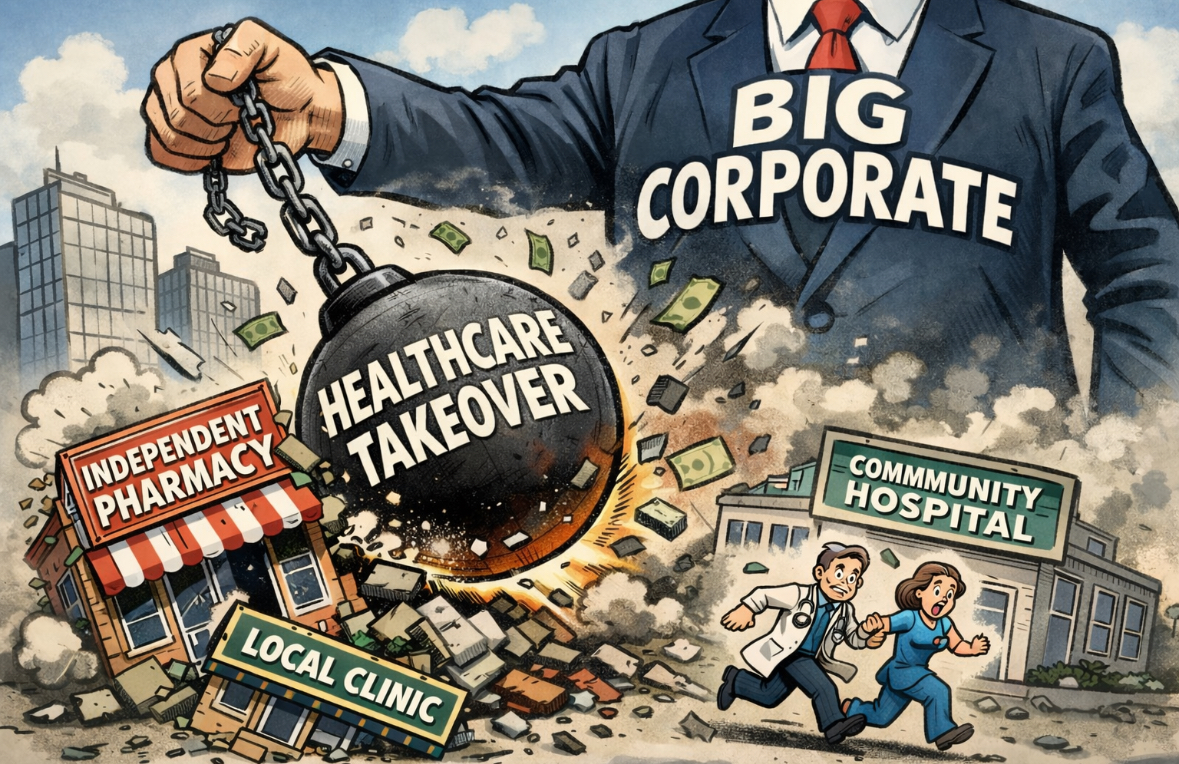
Corporate takeovers are troubling in any industry, but in American health care they become dangerous. Hospitals, nursing homes, physician practices, and emergency departments, once mission-driven institutions, are increasingly absorbed by private equity firms and large health conglomerates whose loyalty lies with investors, not patients. The impact is felt in higher bills, reduced services, understaffing, and, in the most severe cases, preventable harm.
A High-Risk Playbook
Private equity’s takeover model has become a blueprint for extraction: load a facility with debt, cut costs to inflate margins, siphon value through fees and dividends, then exit before the system cracks. What might look like efficiency on paper turns into real-world consequences, longer wait times, fewer staff, deteriorating equipment, and declining quality of care.


Hospitals on the Brink
Across the country, hospitals under corporate control follow a troubling pattern: reduced staffing, slashed community services, aggressive billing practices, and deferred maintenance. When these hospitals falter or close, entire regions lose access to emergency care, maternity wards, and specialty services. Communities are left to absorb the damage while corporate owners walk away insulated from the fallout.
Emergency Rooms Engineered for Revenue

Corporate management of ER staffing has turned emergency medicine into a profit center. Physicians face pressure to see more patients in less time and to generate higher reimbursements. Patients often do not realize their ER doctor works for a private corporation, not the hospital, making surprise billing and aggressive coding more common.
Nursing Homes in Crisis
In long-term care facilities, corporate takeovers often lead to drastic staff cuts, insufficient training, and reduced oversight. Vulnerable residents face declining conditions as owners shield themselves behind complex webs of subsidiaries that obscure responsibility.
Physicians Losing Autonomy

Independent medical practices continue to vanish as corporate chains buy them out to consolidate market power. Doctors report pressure to meet productivity quotas, follow revenue-driven care pathways, and reduce visit times, eroding clinical judgment in favor of financial metrics.
A System at a Breaking Point
Health care cannot be treated like a retail chain or a venture-capital experiment. When corporations dismantle a hospital or gut a nursing home, the consequences are not economic inconveniences, they become matters of life and death. Yet consolidation continues faster than regulators can respond, and with far less public awareness than the stakes demand.
If America allows profit-first takeover strategies to dictate who receives care and how that care is delivered, the system will only grow more unstable, more unequal, and more dangerous.